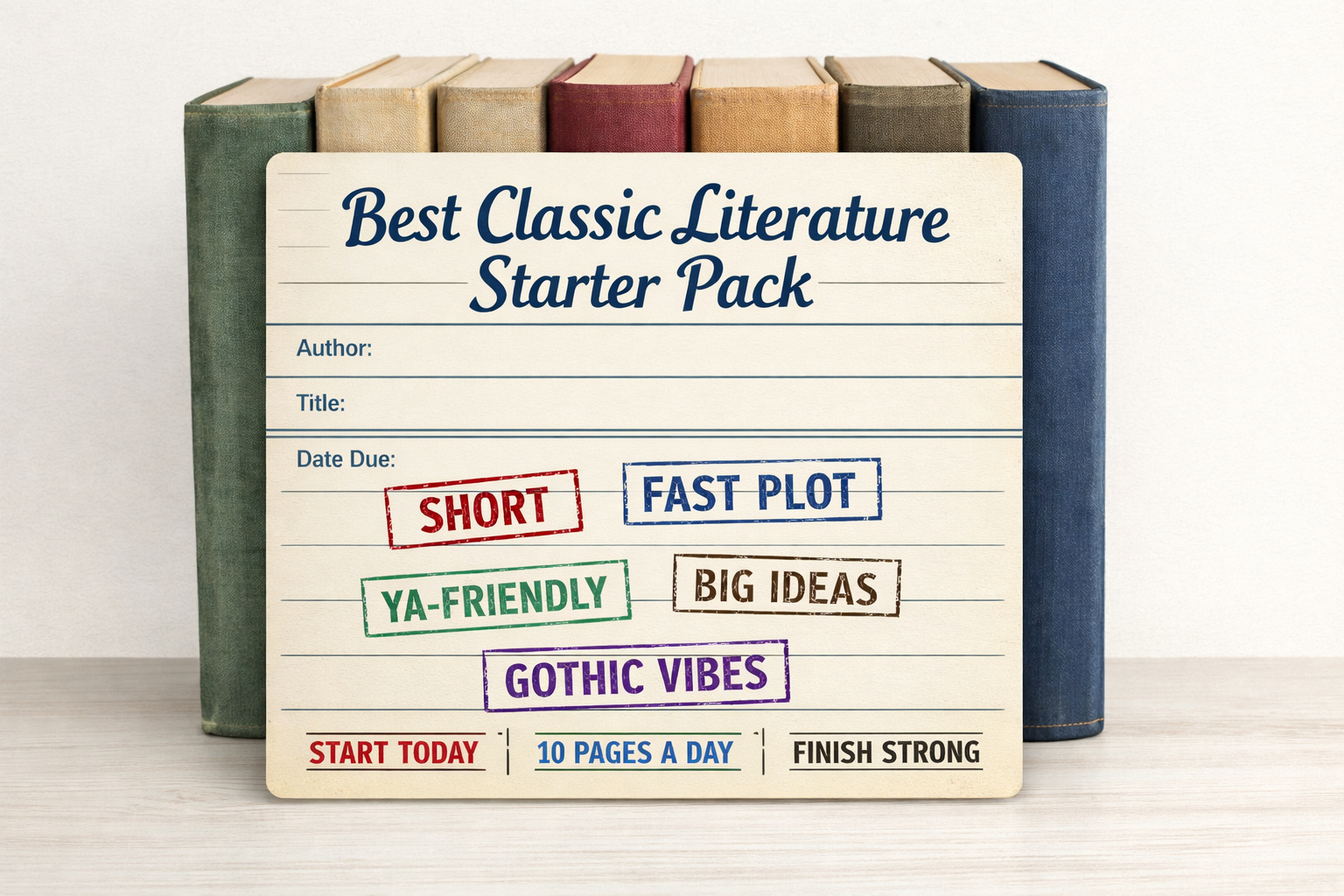
Best classic literature: The Starter Pack That Makes Classics Feel Readable
Classic literature has a reputation for being “important” and also a little intimidating. But you don’t need a literature degree, a fancy reading chair, or a 400-page attention span to enjoy it. You just need a better starting point.
This guide is a curated starter pack of the best classic literature for people who want stories that move, not books that feel like homework. If you’ve ever tried and quit a classic, this is for you.
We’re choosing books by vibe (short, twisty, coming-of-age, high drama), with quick context, light content guidance, and a few optional craft takeaways for writers who want to learn from great literature without overthinking it.
Best classic literature to start with (without feeling lost)
This isn’t a prestige list or a “top 100.” It’s a small, realistic reading list built around:
- Pace: you won’t wait 120 pages for the story to start
- Clarity: strong voice, readable sentences
- Length: a lot of these are approachable in 1–2 weeks
- Relevance: themes still show up in modern books, shows, and movies
Quick Tip: Don’t pick a classic because you “should.” Pick it because the mood fits your current brain. Tired? Go short. Restless? Go mystery. Want feelings? Go coming-of-age.
If you want free access to many public-domain titles, you can explore free public-domain classics while you build your reading habit.
A starter pack of great literature classics (pick your vibe)
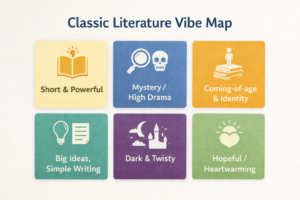
Below are themed mini-starter packs. Each pick includes a one-line hook, why it’s a starter-friendly classic, who it’s best for, and one optional craft takeaway.
1) Short & powerful (when you want impact fast)
The Metamorphosis — Franz Kafka
- Hook: A man wakes up transformed—and life keeps going anyway.
- Why it’s a starter classic: Short, strange, emotionally direct, and surprisingly readable.
- Best for: If you like offbeat stories, surreal vibes, or “what did I just read?” energy.
- Content guidance: isolation, family stress, dark tone.
- Craft takeaway: Kafka shows how to make a bizarre premise feel emotionally real.
Of Mice and Men — John Steinbeck
- Hook: Two friends chase a small dream in a hard world.
- Why it’s a starter classic: Clear language, strong scenes, fast momentum.
- Best for: If you like character-driven stories with big feelings and moral stakes.
- Content guidance: violence, disability themes, harsh living conditions.
- Craft takeaway: Steinbeck is a master of “showing” character through action and dialogue.
2) Fast plot / high drama (for the “I need a story” reader)
Treasure Island — Robert Louis Stevenson
- Hook: A map, a voyage, and the kind of danger you can’t unsee.
- Why it’s a starter classic: Adventure-first pacing, vivid scenes, clean chapters.
- Best for: If you like pirates, quests, and stories that feel like a movie.
- Content guidance: violence, threats, crime.
- Craft takeaway: Stevenson demonstrates how to keep tension alive chapter-to-chapter.
The Hound of the Baskervilles — Arthur Conan Doyle
- Hook: A cursed legend meets a very real investigation.
- Why it’s a starter classic: Mystery structure keeps you turning pages—even if you’re new to classics.
- Best for: If you like detectives, eerie atmospheres, and smart reveals.
- Content guidance: suspense, some violence.
- Craft takeaway: Doyle’s pacing is a clinic in clue placement and escalation.
The War of the Worlds — H.G. Wells
- Hook: An invasion hits, and ordinary life collapses fast.
- Why it’s a starter classic: Straightforward writing, gripping urgency, and a surprisingly modern feel.
- Best for: If you like sci-fi, disaster stories, or survival narratives.
- Content guidance: destruction, death, panic.
- Craft takeaway: Wells shows how to widen stakes while staying grounded in one perspective.
3) Coming-of-age & identity (classic books for young adults that still hit)
To Kill a Mockingbird — Harper Lee
- Hook: A child watches the adult world reveal its faults—and learns what courage really is.
- Why it’s a starter classic: Warm voice, clear storytelling, strong characters.
- Best for: If you like moral questions, family stories, and justice themes.
- Content guidance: racism, injustice, threats/violence.
- Craft takeaway: Lee proves how powerful a “small town” story can be when the character lens is sharp.
The Outsiders — S.E. Hinton
- Hook: Friendship and loyalty collide with class, conflict, and consequence.
- Why it’s a starter classic: Short chapters, fast pacing, accessible voice—one of the easiest entry points.
- Best for: If you want emotional stakes and a “read in a weekend” win.
- Content guidance: gang violence, grief, family instability.
- Craft takeaway: Hinton writes with urgency—every scene pushes the story forward.
The Catcher in the Rye — J.D. Salinger
- Hook: A teen walks through a city and a spiral of feelings he can’t name yet.
- Why it’s a starter classic: Voice-driven and conversational—more internal than plot-heavy.
- Best for: If you like character studies, messy honesty, and emotional realism.
- Content guidance: mental health themes, profanity, drinking.
- Craft takeaway: Salinger is a lesson in voice: you hear the character before you “understand” him.
4) Big ideas, simple writing (for readers who like meaning without confusion)
Animal Farm — George Orwell
- Hook: A revolution promises equality… and then power does what power does.
- Why it’s a starter classic: Short, clear, and easy to follow—even when the ideas are serious.
- Best for: If you like political themes, moral questions, or satire.
- Content guidance: oppression, violence (allegorical).
- Craft takeaway: Orwell shows how to communicate big themes through simple storytelling.
Fahrenheit 451 — Ray Bradbury
- Hook: A society built on distraction starts to crack when one person begins to think.
- Why it’s a starter classic: Quick chapters, strong imagery, and a propulsive concept.
- Best for: If you like dystopias, social commentary, and high-stakes turning points.
- Content guidance: censorship, violence, emotional intensity.
- Craft takeaway: Bradbury uses imagery and rhythm to make ideas feel urgent, not lecture-y.
5) Dark & twisty (for the “give me gothic drama” mood)
Frankenstein — Mary Shelley
- Hook: A creation demands to be seen as human—and the consequences ripple outward.
- Why it’s a starter classic: The language is older, but the emotional core is clear and compelling.
- Best for: If you like gothic tension, moral dilemmas, and “who is the real monster?” questions.
- Content guidance: death, grief, revenge themes.
- Craft takeaway: Shelley shows how framing (letters, retellings) can deepen suspense.
Rebecca — Daphne du Maurier
- Hook: A new marriage, a grand house, and a shadow that won’t leave.
- Why it’s a starter classic: Modern-feeling prose, addictive atmosphere, strong momentum.
- Best for: If you like psychological suspense, slow dread, and obsession themes.
- Content guidance: emotional manipulation, anxiety, references to death.
- Craft takeaway: Du Maurier is brilliant at tension through setting and subtext.
The Picture of Dorian Gray — Oscar Wilde
- Hook: Beauty becomes a bargain—and morality becomes optional.
- Why it’s a starter classic: Witty, sharp, and dramatic; the chapters move with purpose.
- Best for: If you like dark glamour, social satire, and moral horror.
- Content guidance: hedonism, moral decline, some violence.
- Craft takeaway: Wilde shows how voice and dialogue can carry theme without heavy exposition.
Classic books for young adults (that don’t feel like homework)
If you’re shopping for classic books for young adults, look for classics with:
- A strong voice (you can “hear” the narrator)
- Short chapters or clean scene breaks
- Clear stakes (friendship, identity, justice, survival)
- A story that starts quickly (no 60-page warm-up)
- Relatable emotions, even if the setting is old
- Themes that show up in modern media (class, power, belonging, freedom)
Start-here titles (pulled from the list above):
- The Outsiders
- To Kill a Mockingbird
- Animal Farm
- The Hound of the Baskervilles
- Fahrenheit 451
How to read literature classic novels without getting stuck
“Where to start with classics” is one question. “How do I finish?” is the real one. Here’s a simple plan for reading literature classic novels without burning out.
Keep your daily goal small (10–20 pages)
- 10 pages/day = progress without pressure
- 20 pages/day = you finish faster than you think
- If you miss a day, don’t “make up” for it—just continue.
Choose the right edition for your brain
- Modern editions are great when you want flow and readability.
- Annotated editions are great when the language or context keeps tripping you up.
- If you’re pausing every paragraph to Google a word, switch editions. That’s not “cheating.” It’s smart.
Use audiobook + ebook together (the cheat code)
- Listen while reading along for 10 minutes at a time.
- Speed up slightly (1.1–1.25x) if your attention drifts.
- If a chapter is slow, listen to it on a walk—your brain stays engaged.
Don’t force a book you hate
Some classics won’t match your taste, and that’s fine. The goal is to build a habit and confidence—then you can tackle tougher picks later.
Quick Tip: If you’re not hooked by chapter 3 (or page 40), give yourself permission to switch. You’re building momentum, not proving something.
If you want more practical reading lists and author resources, browse the LiberoReads blog and grab what fits your current season.
Great literature (and why it still matters)
A simple way to define classic literature is: stories that continue to be read because they still offer cultural, artistic, or human value across generations. If you want a more formal definition and context, Encyclopaedia Britannica’s classic literature overview is a helpful reference.
But here’s the everyday version: great literature lasts because it keeps telling the truth in new ways. Even when the setting is old, the emotions aren’t—ambition, fear, belonging, love, injustice, hope.
And if you write (or want to), classics quietly teach you craft:
- how to build scenes that mean something
- how voice can carry a book
- how theme can emerge through choices, not speeches
For more general reading and literary resources, the Library of Congress reading resources are worth exploring when you want to go deeper.
Conclusion
Pick one book from the starter pack and make a 7-day plan today. Ten pages a day is enough. One chapter at lunch is enough. The goal isn’t to “conquer” classics—it’s to make them normal.
And if you’re an author who wants your own manuscript to feel clear, polished, and professional, LiberoReads can help—whether you’re looking for Manuscript Evaluation / Developmental Ed, Copyediting / Line Editing, Proofreading, Interior Formatting (Typesetting), or Cover Design (Custom). You can explore options on the Book Publishing Services for Authors page.